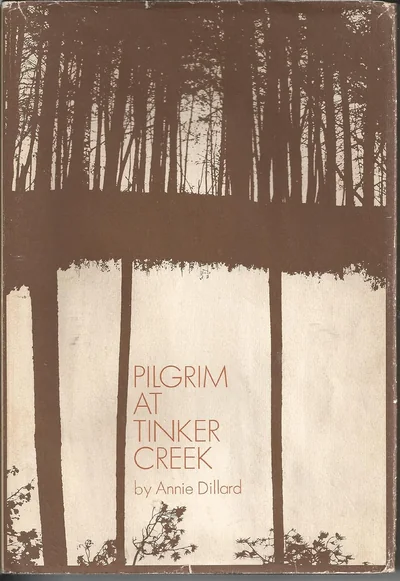
Publication Details
Reading Details
Highlights
I used to have a cat, an old fighting tom, who would jump through the open window by my bed in the middle of the night and land on my chest. I’d half-awaken. He’d stick his skull under my nose and purr, stinking of urine and blood. Some nights he kneaded my bare chest with his front paws, powerfully, arching his back, as if sharpening his claws, or pummeling a mother for milk. And some mornings I’d wake in daylight to find my body covered with paw prints in blood; I looked as though I’d been painted with roses.
-
Some unwonted, taught pride diverts us from our original intent, which is to explore the neighborhood, view the landscape, to discover at least where it is that we have been so startlingly set down, if we can’t learn why
-
It is dire poverty indeed when a man is so malnourished and fatigued that he won’t stoop to pick up a penny. But if you cultivate a healthy poverty and simplicity, so that finding a penny will literally make your day, then, since the world is in fact planted in pennies, you have with your poverty bought a lifetime of days. It is that simple. What you see is what you get.
-
Fish gotta swim and birds gotta fly; insects, it seems, gotta do one horrible thing after another.
-
Nature is, above all, profligate. Don’t believe them when they tell you how economical and thrifty nature is, whose leaves return to the soil. Wouldn’t it be cheaper to leave them on the tree in the first place?
-
“Never lose a holy curiosity,” Einstein said;
-
A rosy, complex light fills my kitchen at the end of these lengthening June days. From an explosion on a nearby star eight minutes ago, the light zips through space, particle-wave, strikes the planet, angles on the continent, and filters through a mesh of land dust: clay bits, sod bits, tiny wind-borne insects, bacteria, shreds of wing and leg, gravel dust, grits of carbon, and dried cells of grass, bark, and leaves. Reddened, the light inclines into this valley over the green western mountains; it sifts between pine needles on northern slopes, and through all the mountain black-jack oak and haw, whose leaves are unclenching, one by one, and making an intricate, toothed and lobed haze. The light crosses the valley, threads through the screen on my open kitchen window, and gilds the painted wall. A plank of brightness bends from the wall and extends over the goldfish bowl on the table where I sit. The goldfish’s side catches the light and bats it my way; I’ve an eyeful of fish-scale and star.
-
This is our life, these are our lighted seasons, and then we die. (You die, you die; first you go wet, and then you go dry.) In the meantime, in between time, we can see. The scales are fallen from our eyes, the cataracts are cut away, and we can work at making sense of the color-patches we see in an effort to discover where we so incontrovertibly are. It’s common sense: when you move in, you try to learn the neighborhood.
-
Our life is a faint tracing on the surface of mystery.
-
Evolution loves death more than it loves you or me. This is easy to write, easy to read, and hard to believe. The words are simple, the concept clear—but you don’t believe it, do you? Nor do I. How could I, when we’re both so lovable? Are my values then so diametrically opposed to those that nature preserves? This is the key point.
-
Look: Cock Robin may die the most gruesome of slow deaths, and nature is no less pleased; the sun comes up, the creek rolls on, the survivors still sing. I cannot feel that way about your death, nor you about mine, nor either of us about the robin’s—or even the barnacles’. We value the individual supremely, and nature values him not a whit. It looks for the moment as though I might have to reject this creek life unless I want to be utterly brutalized. Is human culture with its values my only real home after all? Can it possibly be that I should move my anchor-hold to the side of a library? This direction of thought brings me abruptly to a fork in the road where I stand paralyzed, unwilling to go on, for both ways lead to madness.
Either this world, my mother, is a monster, or I myself am a freak. -
Instead of one goldfish swimming in its intricate bowl, I see tons and tons of goldfish laying and eating billions and billions of eggs. The point of all the eggs is of course to make goldfish one by one—nature loves the idea of the individual, if not the individual himself—and the point of a goldfish is pizzazz. This is familiar ground. I merely failed to mention that it is death that is spinning the globe.
-
But he never knew I was there.
I never knew I was there, either. For that forty minutes last night I was as purely sensitive and mute as a photographic plate; I received impressions, but I did not print out captions. My own self-awareness had disappeared; it seems now almost as though, had I been wired with electrodes, my EEG would have been flat. I have done this sort of thing so often that I have lost self-consciousness about moving slowly and halting suddenly; it is second nature to me now. And I have often noticed that even a few minutes of this self-forgetfulness is tremendously invigorating. I wonder if we do not waste most of our energy just by spending every waking minute saying hello to ourselves. Martin Buber quotes an old Hasid master who said, “When you walk across the fields with your mind pure and holy, then from all the stones, and all growing things, and all animals, the sparks of their soul come out and cling to you, and then they are purified and become a holy fire in you.” This is one way of describing the energy that comes, using the specialized Kabbalistic vocabulary of Hasidism. -
I am a frayed and nibbled survivor in a fallen world, and I am getting along. I am aging and eaten and have done my share of eating too. I am not washed and beautiful, in control of a shining world in which everything fits, but instead am wandering awed about on a splintered wreck I’ve come to care for, whose gnawed trees breathe a delicate air, whose bloodied and scarred creatures are my dearest companions, and whose beauty beats and shines not in its imperfections but overwhelmingly in spite of them, under the wind-rent clouds, upstream and down. Simone Weil says simply, “Let us love the country of here below. It is real; it offers resistance to love.”
-
The year was rolling down, and a vital curve had been reached, the tilt that gives way to headlong rush. And when the monarchs had passed and were gone, the skies were vacant, the air poised. The dark night into which the year was plunging was not a sleep but an awakening, a new and necessary austerity, the sparer climate for which I longed. The shed trees were brittle and still, the creek light and cold, and my spirit holding its breath.
-
I have glutted on richness and welcome hyssop. This distant silver November sky, these sere branches of trees, shed and bearing their pure and secret colors—this is the real world, not the world gilded and pearled. I stand under wiped skies directly, naked, without intercessors. Frost winds have lofted my body’s bones with all their restless sprints to an airborne raven’s glide. I am buoyed by a calm and effortless longing, an angled pitch of the will, like the set of the wings of the monarch which climbed a hill by falling still.