I enjoy seeing how an author chooses to begin.

I first met Dean not long after my wife and I split up. I had just gotten over a serious illness that I won’t bother to talk about, except that it had something to do with the miserably weary split-up and my feeling that everything was dead. With the coming of Dean Moriarty began the part of my life you could call my life on the road. Before that I’d often dreamed of going West to see the country, always vaguely planning and never taking off. Dean is the perfect guy for the road because he actually was born on the road, when his parents were passing through Salt Lake City in 1926, in a jalopy, on their way to Los Angeles. First reports of him came to me through Chad King, who’d shown me a few letters from him written in a New Mexico reform school. I was tremendously interested in the letters because they so naively and sweetly asked Chad to teach him all about Nietzsche and all the wonderful intellectual things that Chad knew. At one point Carlo and I talked about the letters and wondered if we would ever meet the strange Dean Moriarty. This is all far back, when Dean was not the way he is today, when he was a young jailkid shrouded in mystery. Then news came that Dean was out of reform school and was coming to New York for the first time; also there was talk that he had just married a girl called Marylou.

The town is Galloway. The Merrimac River, broad and placid, flows down to it from the New Hampshire hills, broken at the falls to make frothy havoc on the rocks, foaming on over ancient stone towards a place where the river suddenly swings about in a wide and peaceful basin, moving on now around the flank of the town, on to places known as Lawrence and Haverhill, through a wooded valley, and on to the sea at Plum Island, where the river enters an infinity of waters and is gone. Somewhere far north of Galloway, in headwaters close to Canada, the river is continually fed and made to brim out of endless sources and unfathomable springs.

"Prod and pull,” the old woman was saying, “’tis the way of the Empress, as like the gods themselves.” She leaned to one side and spat, then brought a soiled cloth to her wrinkled lips. “Three husbands and two sons I saw off to war."

Most Japanese girls giggle. The Litttle maid on the fourth floor of the Miyako Hotel, in Kyoto, was no exceptgion. Hilarity, and attempts to suppress it, pinked her cheeks (unlike the Chinese, the Japanese complexion more often than not has considerable color), shook her plump peony-and-pansy-kimonoed figure. There seemed to be no particular reason for this merriment; the Japanese giggle operates without apparent motivation.

My name is Rex. I am a Good Dog.

They crouched with their rifles in the pineapple field, watching a man teach his son how to ride a horse. It was the summer of 1902 in Hawaii.

My part of the affair started on Septhember 18th, when my chief sent for me and told me he was transferring me to Saxmere on the east coast. He was sorry about it, he said, but I was the only one with the ncecessary technical qualifications for the particular work they had on hand. No, he couldn't give me any details; they were an odd lot down there, and shut themselves up behind barbed wire at the slightest provocation. The place had been a radar experimental station a few years back, but this was finished, and any experiments that were going on now were of an entirely different nature, something to do with vibrations and the pitch of sound.

and Cyril Bagger considers himself lucky, he ought to be topped off, gone west, bumped, clicked it, pushing daisies, a new landowner, napooed, just plain dead, not only dead but scattered around in globs, for the last thing he saw was a shell dropping on top of him with the noise of colliding freight trains, a jim-dandy of a shot from Fritzy the Hun, and kind of ironic, seeing how the whole reason Bagger prefers burial duty is artillery shells can’t reach this far behind the frontline trench, but this shell sure did, the way he always pictures it in dreams, a red skull of fire screaming down, giving him one second to think, That old Bagger luck has finally run out,

His skin told his history in tattoos and knife scars. He lived in a room with no night. And he was to his own mind a god.

The Nellie, a cruising yawl, swung to her anchor without a flutter of
the sails, and was at rest. The flood had made, the wind was nearly
calm, and being bound down the river, the only thing for it was to come
to and wait for the turn of the tide.

Three Indians were standing out in front of the post office that hot summer morning when the motorcycle blazed down Walnut Street and caused Mel Weatherwax to back his pickup truck over the cowboy who was loading sacks of lime. The man and woman on the motorcycle probably didn't even see the accident they had caused, they went by so fast. Both of them were wearing heavy-rimmed goggles, and all Mel saw was the red morotcycle, the goggles, and two heads of hair, black for him and blond for her. But everybody forgot about them; the cowboy was badly hurt, lying there in the reddish dust cursing, his face gone white from pain. The Indians stayed up on the board sidewalk and watched while Mel Weatherwax and one of his hands carried the hurt cowboy into the shade of the alley beside the store.

So. The Spear-Danes in days gone by
and the kings who rule them had courage and greatness.
We have heard of those princes' heroic campaigns.

I came to Comala because I was told my father lived here, a man named Pedro Páramo. That's what my mother told me. And I promised her I'd come see him as soon as she died. I squeezed her hands as a sign I would. After all, she was near death, and I was of a mind to promise her anything. "Don't fail to visit him —she urged—. Some call him one thing, some another. I'm sure he'd love to meet you." That's why I couldn't refuse her, and after agreeing so many times I just kept at it until I had to struggle to free my hands from hers, which were now without life.

I am simply copying down the announcement that appeared in today's One State Gazette word for word:

Sunday, 21 June 1941, produced a perfect summer's morning. Many Berliners took the train out to Potsdam to spend the day in the park of Sans Souci. Others went swimming from the beaches of the Wannsee or the Nikolassee. In cafés, the rich repertoire of jokes about Rudof Hess's flilght to Britain had given way to stories about an imminent invasion of the Soviet Union. Others, dismayed at the idea of a much wider war, rested their hopes upon the idea that Stalin would cede the Ukraine to Germany at the last moment.

A squat grey building of only thirty-four stories. Over the main entrance the words, CENTRAL LONDON HATCHERY AND CONDITIONING CENTRE, and, in a shield, the World State's motto, COMMUNITY, IDENTITY, STABILITY.

'Yes, of course, if it’s fine tomorrow,’ said Mrs Ramsay. 'But you’ll have to be up with the lark,' she added.
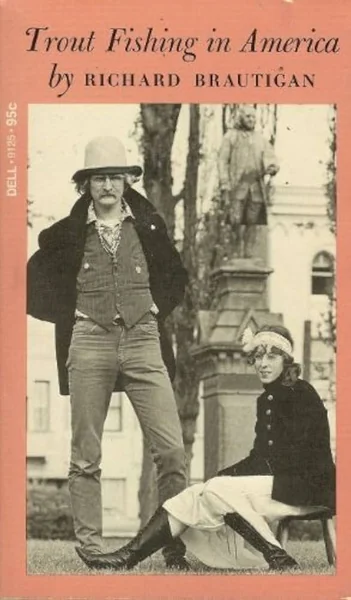
The cover for Trout Fishing in America is a photograph taken late in the afternoon, a photograph of the Benjamin Franklin statue in San Francisco's Washington Square. Born 1706--Died 1790, Benjamin Franklin stands on a pedestal that looks like a house containing stone furniture. He holds some papers in one hand and his hat in the other. Then the statue speaks, saying in marble:
PRESENTED BY H. D. COGSWELL TO OUR BOYS AND GIRLS WHO WILL SOON TAKE OUR PLACES AND PASS ON.

In the town there were two mutes, and they were always together. Early every morning they would come out from the house where they lived and walk arm in arm down the street to work. The two friends were very different. The one who always steered the way was an obese and dreamy Greek. In the summer he would come out wearing a yellow or green polo shirt stuffed sloppily into his trousers in front and hanging loose behind. When it was colder he wore over this a shapeless gray sweater. His face was round and oily, with half-closed eyelids and lips that curved in a gentle, stupid smile. The other mute was tall. His eyes had a quick, intelligent expression. He was always immaculate and very soberly dressed.

My Dear Fellow Clergymen:
While confined here in the Birmingham city jail, I came across your recent statement calling my present activities 'unwise and untimely.'